 Homebar.io
Previous Work
Site Search Enhancement
The Whole Story
If I could give one piece of wisdom to any tech professional, it would be this: Build your own product.
Life is different when you have a code issue and the ‘fix’ is more complex than pinging the engineering team and them saying ‘No problem – I got it.’
You’re your own marketing team. Your own sales team. Your own editor, designer, engineer and leader. You’re forced to learn and problem solve. And it gives you certain skills you just don’t get working in house at an organization. The beauty of it is this: It makes you a better worker when you do work in house somewhere. Suddenly you view things like you’re a member of the marketing team, or the sales team. Your product worldview changes. You approach product decisions holistically.
I’m not going to tell you ‘The Whole Story’ of Homebar.io. If I did, you’d have to read a novel; there’s just so much to tell from a company and product I started four years ago. Instead, I’m going to share my learnings–what’s worked, what hasn’t, and where I still need to get better.
Don’t Forget Why You Started
When I first started Homebar.io, my attention was pulled all over the place. My initial inclination was to ‘package’ the home bartending learning aspect into a bottle inventory tracking app. Being a digital product person, this felt right. Give them utility first, and the app can be a vessel for learning content. This was further compounded by my deep dive into spirits, particularly whiskey. Collectors were asking for an app where they could track their collection and I knew I could build it. Product research, right? I was getting a handful of interested voices asking for it. So, I built it.
At first, I had a few great months! Signup after signup. Then after the excitement, the product growth fell off a cliff. Trying to assess how I could restart the momentum, I reached out to some of our most engaged users for some user interviews. I set up 1o sessions which had some striking results. To summarize, users liked what I had created; but when asked if they would even pay a few dollars per month for it, the generalized sentiment was ‘I like it, but…probably not enough to pay for it.’ When I asked what features they’d like to see that would be worth paying for or other improvements, they mostly shrugged. One even said “I’d just switch to Google Sheets if this ended up being something I had to pay for.’ When I asked if learning how to make cocktails would be a useful addition to the app, the sentiment was ‘Not for me. I pretty much just drink whiskey neat and an occasional Old Fashioned.’
I fell for the trap of chasing the first shiny thing that came my way. In my haste to build something of value I got lost in the plot and missed my target audience completely. Sure, I could continue working on getting growth, but if it meant only a free product that wouldn’t be something I could support long term, that wouldn’t be good for me nor my current users. Plus, my passion wasn’t in inventory tracking. I had meandered away from my initial hypothesis: The difficulty of learning to make cocktails at home. Instead I became hyper-focused on building something. Anything.
I course corrected by doing research strictly on my core pain point: learning how to make great cocktails at home. Thankfully, I got some great signals from others that this was a pain point just like I had experienced. Stronger than the inventory tracking app, even. So I shifted back to my original mission.
What Makes You Different is Your Secret Sauce
The bottle collection app I had made was pretty user-friendly – at least for inventory apps. But even with the initial interest of that app, my users said they used apps that were really similar and those had met their needs just as well. When I pressed, they said that there were a few things that they felt could be improved with those other apps, but certainly nothing that would be a reasonable paid feature that I could build upon within my own app.
Essentially, my app was just another app among a handful of apps that did the same exact thing. I had no secret sauce, and no way to make their high-end dreams come true with just my little ol’ self working on it (things like knowing when rare whiskey dropped at their local stores, or being able to tap into state minimum prices in all 50 states when no APIs existed for that). I had no unique selling proposition.
I took that learning into my mission of teaching home bartending. I leaned into the aspect of ‘nobody else is doing this’. I did my competitive analysis, researched everything from large companies down to small ones to see how I could be uniquely valuable in this space. In the end, I came up with a barware kit that set our customers up for proper learning: One cocktail to make and one set of barware and instructions for how to make it. It’s that simple. And when you’ve mastered that single cocktail, you can make variations and use the barware to make other cocktails that call for that barware. Start small and expand from there. We thought from the challenge aspect and built out a service offering around it. That’s what made us different than anyone else.
Your Product Isn’t Your Product: A Better Version of Your Customer is.
Your product is actually what it enables your customer to do. This is something I had a hard time applying at first. Apple’s MacBook doesn’t just have Logic Pro; it makes you a better music producer. The Peloton isn’t a bike; it’s a healthier version of you.
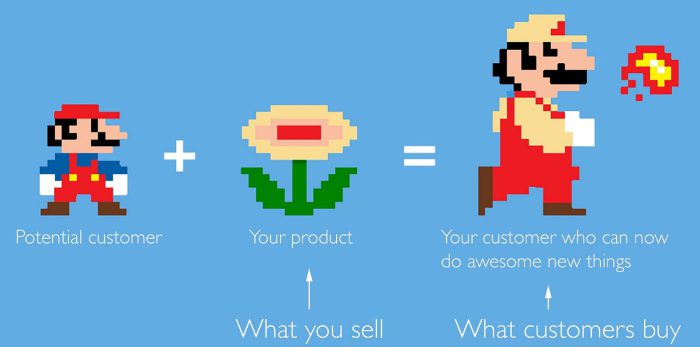
Credit for this useful image goes to Samuel Hulick, a UX designer and the founder of UserOnboard.
By no means did I invent this concept; it’s a part of the ‘Jobs to be Done’ framework. But as much as I agreed with it and understood it, I had a hard time applying it to my business. Yeah, making cocktails at home is great, but what superpower does it give my customers? Well, when cocktails are a whopping $15-$23 these days, it allows them to save money and apply it to other things. It allows them to ensure they can spend time with friends and family during their get togethers instead of being stuck behind the bar making drinks all night (This is where I usually mention ‘batched cocktails’).
Don’t Boil The Ocean
At first, I thought success meant standing out on multiple platforms; specific content reels on Instagram, other content formats for YouTube, running a Patreon, you name it. But when you’re the only one working on several things, you’re stretching yourself too thin. And to be honest, there’s no need for it. Choose a social platform and stick to it. Whichever one seems to have an audience that resonates best with your content. Choose the marketing activity that gives you the best return (whether that be email marketing, podcasting, etc).
Most importantly, create processes that put your business activities on autopilot. Find the efficiencies and win your time back.
Conclusion
While I have learned these key items in my solo product journey, I still have a lot of learning to do. And a lot of room to grow. For now, Homebar.io will be my side project that I hope someday becomes my full time endeavor. Until then, I’ll take my learnings and apply them to whatever organization or product I serve.
Be a product person. You won’t regret it.