 Dept. of Veteran Affairs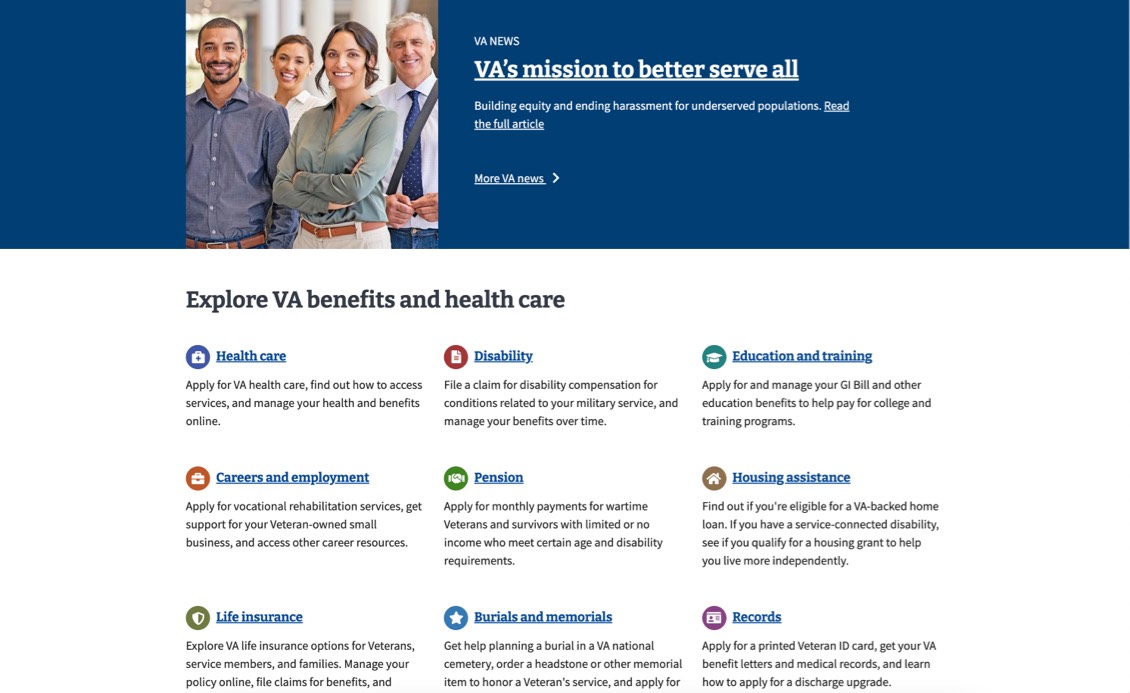
Previous Work
KC Catering
The Whole Story
The first day of work after contracting to improve the VA.gov website was a bit disorienting. There were so many apps within the website that did so many things. Some were specific to benefits, some more specific to the VA Medical Centers, burials, home loans…the list goes on. The entirety of the team for the contract had around 100 personnel, so breaking them off into teams and having staff focus on specific areas of the site made sense.
It felt somewhat like having the Sorting Hat in Harry Potter put you into a house; but instead of a common room with highback leather chairs, we were given parts of a website that were in dire need of help. I was lucky enough to get one of the biggest, most used aspects of the website which was called Benefits and Memorials (was this the equivalent of Gryffindor?). This was the suite of apps that included the main disability compensation application (526ez Form) and the Claim Status Tool (where Veterans could check on any and all claims they had with the VA). It was a bit intimidating because contract leadership described our team as expected to be a ’10x team’ – and in our context, that meant we needed to provide high value in a short time.
So there we were – just a team of 8, taking on the biggest forms the VA website had. Our first stop was the 526ez Disability Compensation application. The big boy. The one that Veterans and their caregivers used to file a claim for their disabilities resulting from their service. We set out to improve the experience of this form by doing two separate things:
- Evaluate the need for certain questions on the form, with the possibility of eliminating them for convenience’s sake, and
- Understanding what other forms are affected by this form or branch off from this form. Yes, that was a thing. And it made a lot of difference.
In doing so, we found value in something called Benefits Delivery at Discharge (BDD). This was a service that was provided to active service members and allowed them to claim disability benefits before separating from their military service. It was very specific; you needed to fill out the form/provide your claim(s) anywhere from 180-90 days out from separation. If you did this however, it was way easier for the adjudicators to process your claim, because it was much easier to refer to active records than digging out past records and it went into a different queue than the standard claim. If memory serves, it allowed most service members to have their claims processed in as little as 90 days, which was much faster than most claims submitted after the BDD window (standard VA claims).
Since BDD was such a potential value that branched off from the main 526ez form, we set out making this form a reality on the VA website. We evaluated the paper form, determined where conditional logic from the 526 form could introduce the claimant to BDD and escort them into the BDD flow if applicable, and put this branching form into testing. Our last step was doing User Acceptance Testing (UAT), where we launched our new product and reached out to Veterans (or in the case of BDD, active service members) and asked them if they wanted to test our product while doing a real life claim.
It was during one of our UAT sessions that I caught something that gave me pause. Our Veteran participant was in good spirits, but the moment he encountered the digital form fields prompting him to describe his battle experience, his demeanor changed. His breath quickened and he stopped typing. “I’m sorry, but do you mind if I take a quick break? I’m gonna go grab some coffee” he said. “Absolutely, take all the time you need” I responded.
I wasn’t used to this. I had never worked on a product like this before, and the internal folks at the VA never raised any concerns about the form fields being potentially problematic. Going in, I didn’t recognize this issue. But as soon as I saw our participant behaving differently, alarm bells went off.
I set up an urgent meeting with a higher level stakeholder within the VA. I told them my concerns. “I believe the participant we had in UAT today was triggered by the questions relating to his PTSD claim.” I recounted the story and the stakeholder was quick to agree with my assessment. I had immediate agency to look into this issue and find solutions to limit or (hopefully) eliminate the problematic questions on the form. So, I made it my #1 priority and got to work.
Step 1: Stakeholder Interviews
Our first step was to determine which of these questions was likely problematic. But how would we accomplish that? Sure, we saw one very clear question that was an issue, but it’s very possible there were more. It would be unethical and immoral for us to ask Veterans to go through a potentially triggering form flow, so that wouldn’t be possible. So instead we pivoted by asking the question: Who else would be able to tell us what is truly triggering?
The answer was in two places: The VA therapists and the Veteran Service Officers. The therapists are the folks who actually provide care for Veterans who have PTSD and evaluate the claim. So if a Veteran fills out on the form that they have PTSD, they will speak with a therapist during the process of substantiating their claim. Next, the Veteran Service Officers were the folks who would work on the behalf of Veterans to assist them in filing their claim. We reasoned that if we were able to speak with them, we were likely to identify the triggering questions and eliminate them as part of the form.
We spoke 2 VA therapists and 3 VSOs, evaluating the form in working sessions to identify which ones were likely triggering and wrote up a proposal for our VA leadership to remove certain fields. Equipped with the SME feedback, we were ready to see if we could make a change.
Step 2: Framing a Potential Solution
Plan in hand, we went to VA leadership and met with the internal subject matter experts. Here’s what we proposed: Any Veteran or service member making a claim of PTSD would be required to have an evaluation with the VA therapists. When the therapists ask about their PTSD experience, they ask the same or similar questions as the form itself does. So, our proposal was to remove the questions/form fields relating to PTSD experience and then the VA therapist evaluation would be enough to substantiate the information necessary to move their disability claim forward. Simple, right?
Well…no. When we spoke to the adjudicators, they made it clear: Not having that information would slow down the processing of the claim. This is because as soon as a Veteran fills out that form, the adjudicators get to work substantiating the claim on their end. So if a Veteran enters in the battle experience they had on the form, the adjudicators then take a look at the Veteran’s record of service, confirming if they were deployed, where they were deployed and cross-referencing details for the claim. So, in the end, delaying that information until a therapist could get to it meant delaying the claim entirely. And that was certainly a non-negotiable. We wanted claims to get done more thoughtfully, compassionately and quickly.
So this put us back at the drawing board. How could we approach a solution to this problem in a way that both considered the human aspect–both for the claimant and the adjudicators/VA staff?
A Crucial Loophole
As we were brainstorming just a day afterwards, an email came through to our team. It was from someone we presented our ideas to in the meeting previous. It went something like this:
“I really appreciate the meeting yesterday and your goal of reducing potentially triggering questions on the 526ez form. I was thinking of possible solutions. One way we can eliminate all of those questions in our process is if the Veteran has been awarded medals or citations. That’s already recorded, so we can just reference that instead of having the Veteran add the information again. That would be enough to substantiate the claim.”
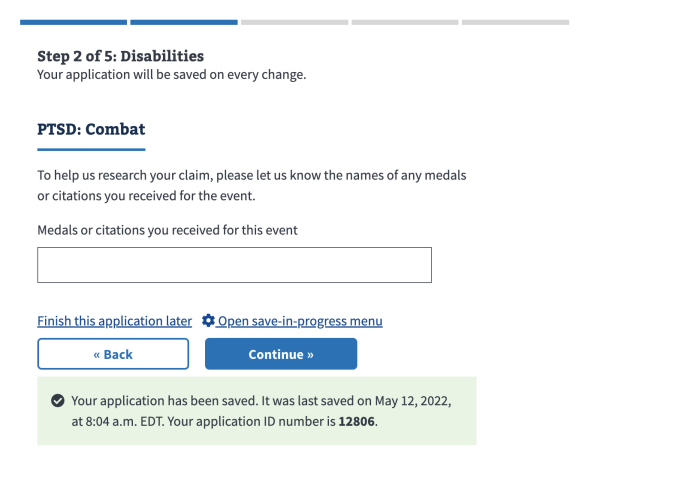
Bingo. That was the lead we needed! We ran to our VA leader and asked for permission to implement that change immediately, which was met with a quick and resounding ‘yes’. So, if a Veteran answers ‘yes’ to the medals and citations question, they do not have to provide any where/what/when questions in the process.
Step 3: Implementing Our Solution
So the plan was to move the medals and citations question to the front of the form, so it could be asked early and therefore eliminate the questions for those who had received them. And within a week, we had made the change. It was simply a matter of moving the question earlier in the form process and conditionally hiding the other PTSD-related questions if a Veteran selected ‘yes’ to this question.
For us, this was a huge win. It was a quick turnaround, it completely eliminated the need for these questions for an entire group of Veterans, and it made the form more efficient. Still, we weren’t done.
Conclusion + Looking Forward
While this met our requirements of being more compassionate and efficient, it didn’t fix the problem entirely. So we weren’t done.
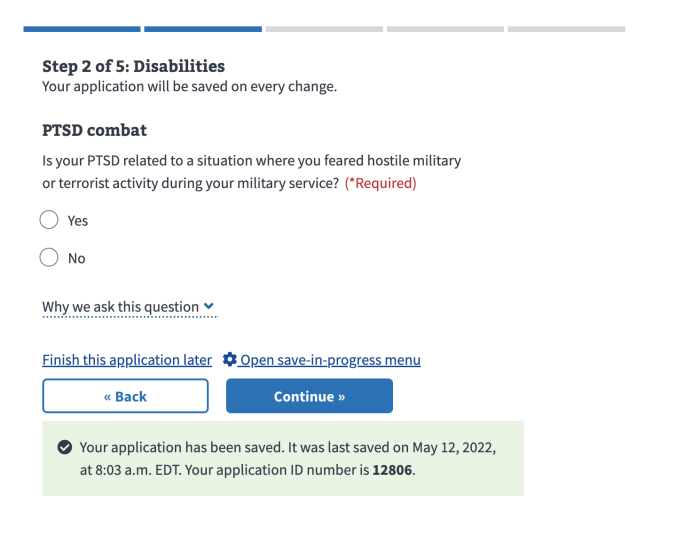
Some time later, when speaking with the internal VA team we determined that creating specific language on a certain form field could help our cause even further. If a Veteran claimed that their PTSD was related to a situation fearing hostile military or terrorist activity during their service, this would cover a larger body of Veterans who would then not need to answer any subsequent triggering questions on the form. Instead, answering ‘yes’ to this field would immediately qualify them to see a VA Therapist to evaluate the PTSD claim. No more awful details to input.
This was huge. This is the accomplishment I was most proud of when working on contract with the Department of Veteran Affairs. We did other wonderful things in different areas during my three-year run on the contract, but this was the one where I had hoped myself and the team made the biggest impact. And by the time I had left the contract, there was still work to be done on it. Completely and totally eliminating triggering questions on a claim of PTSD was the goal and while we had made massive changes toward that end, that had not been fully realized. There were still a smaller set of individuals that may have experienced PTSD that was not related to combat zones, or did not receive medals or citations. My hope is that the team after us picked up the mantle of our work and ran it to the finish line.
As designers and researchers, we are empaths. Our job is to consider the human element. Being able to give back to Veterans in just this small way made me feel like I had finally done something to truly help our nation’s heroes.